Entry No. 55 — the Kansas City file — filed under: oddities
Leila’s Hair Museum
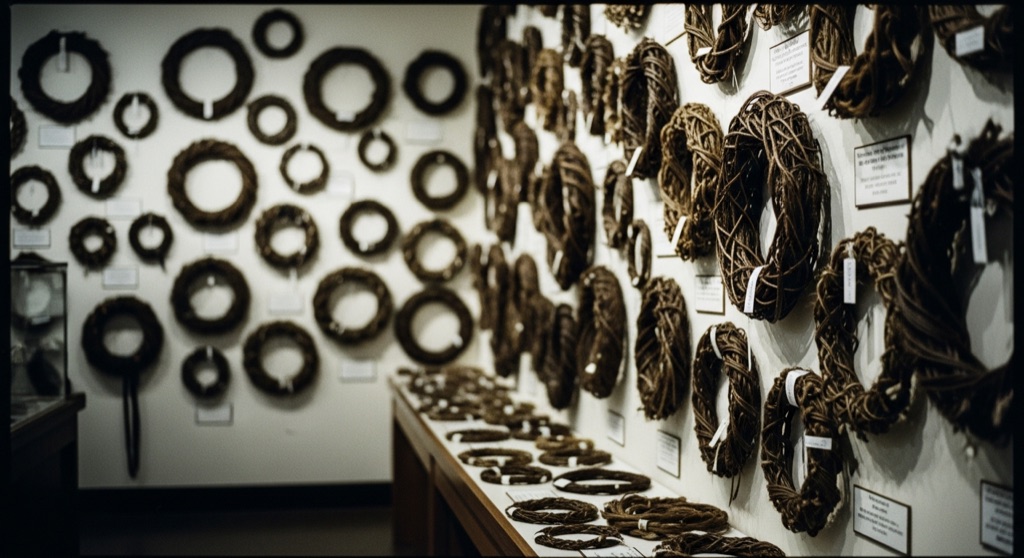
The world’s only museum devoted to hair art — more than 600 wreaths and 2,000 pieces of jewelry woven from human hair, a Victorian mourning custom, with strands attributed to Queen Victoria, Marilyn Monroe, and four U.S. presidents, collected by former cosmetology instructor Leila Cohoon.
→ Three more oddity shops & curiosities in Kansas City — never the same twice
The story
Before you judge the concept of framing human locks, remember that Victorians did not have photo albums—they had shears, wire, and an intense relationship with grief. Former cosmetology instructor and Kansas City Coiffeur Guild officer Leila Cohoon spent decades assembling the world’s definitive shrine to this forgotten craft. What started as a personal collecting habit grew into an Independence museum holding over 600 wreaths and 2,000 pieces of hair jewelry, preserving a 19th-century ritual that blurred the line between sentimental memory and taxidermy.
The technique itself is staggering once you stand six inches from the glass. Victorians snipped, wire-wrapped, and braided human hair into delicate floral arrangements, horseshoe wreaths, and gold-cased brooches. Some pieces acted as living family trees—where each petal was formed from a different relative's hair—while others were mourning keepsakes crafted after a burial. Display cases held verified strands attributed to Queen Victoria, Marilyn Monroe, and four U.S. presidents, proving that keeping a piece of someone's crown was once considered peak romance and high sentiment.
After 39 years of operation on Noland Road, the original museum storefront closed its doors in late 2025, though the historic collection was saved. It stands as a testament to Cohoon's single-handed effort to document a dying art form, capturing an era when love and loss were woven directly into hand-crafted wire frames.
What it's like
Visiting the museum was a lesson in micro-craftsmanship that quickly cured any initial creep factor. Inside, what looked like fine lace or velvet filigree from a distance revealed itself as hundreds of individual strands of human hair wrapped around wire to form tiny chrysanthemums and dahlias. Docent tours walked you through the strict etiquette of Victorian mourning art, explaining how silver, auburn, and black hair were sorted and bound into shadowboxes. Since the Noland Road venue closed in late 2025 after nearly four decades, keep your eyes on local historic preservation updates to see where Cohoon’s saved collection surfaces next.
The move: Take the docent-led walk-through that explains the mourning-hair tradition, then decide together whether the intricate woven wreaths are beautiful, macabre, or both — an unusually good conversation of a date.
📍 Before you go By appointment / limited hours — call ahead. In Independence, ~10 miles east of downtown KC.
- 📍 Independence
- 💸 $$
- ⚡ Up for anything
- 🌗 Indoors
Where: 1333 S Noland Rd, Independence, MO 64055
Hours: Added 2026-07-21 — confirm current hours before you go.
Pair it with
- Puppetry Arts Institute — Pair two hyper-niche Independence institutions dedicated to intricate, slightly unsettling handcrafts.
- Pitcher Cemetery — Follow up Victorian hair-mourning history with a walk through a tiny pioneer graveyard tucked into an Independence neighborhood.
- Elmwood Cemetery — Trace the 19th-century obsession with mortality from hair brooches out to grand Victorian funerary architecture.
- For Strange Women — Shift from Victorian hair relics to natural botanical perfumes crafted with a similarly dark, historic aesthetic.
More weird in Kansas City
Good to know
What actually is Victorian hair art?
It is an 18th- and 19th-century handcraft where human hair was braided, wire-wrapped, or woven into jewelry, wreaths, and shadowbox displays to memorialize the dead or keep a tangible record of living family members.
Whose hair was featured in the collection?
The collection includes strands attributed to Queen Victoria, Marilyn Monroe, and four U.S. presidents, displayed alongside thousands of anonymous family heirlooms.
Is Leila's Hair Museum still open at its Noland Road location?
No. After 39 years in Independence, the physical museum on Noland Road closed in October 2025, though the collection was preserved.
How did artists turn loose hair into solid wreaths and jewelry?
Crafters used tiny wire forms, small looms, and palette work to shape strands into rigid petals, rings, and brooches without destroying the hair fiber.
Plan a visit & invite your people →
Further reading: hairwork.com · Atlas Obscura · kcur.org · dailyrecordnews.com · Reddit
last checked: 2026-07-21