Entry No. 72 — the Fort Collins file — filed under: ruins
The Birch Ruins
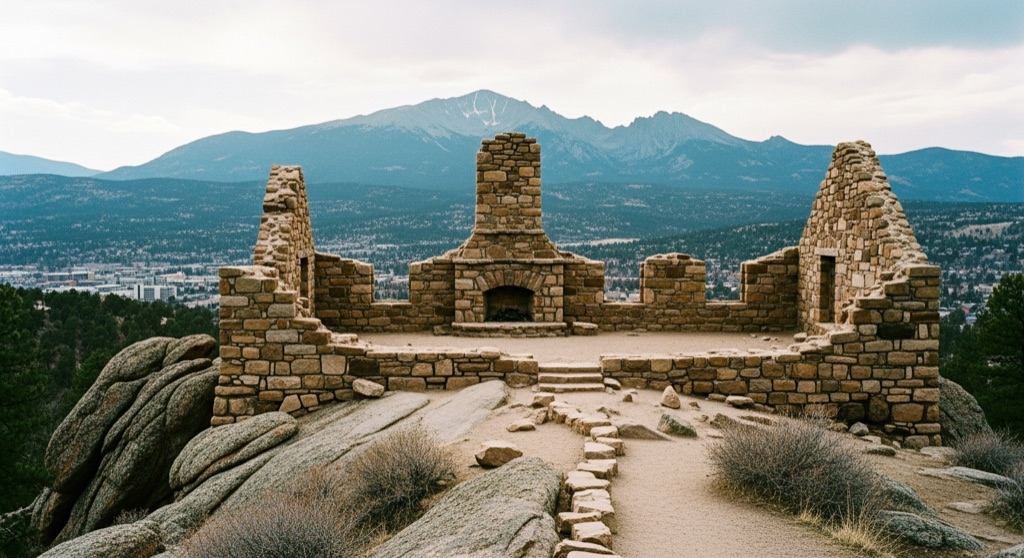
Perched on a 75-foot rocky outcropping in the Knoll-Willows Open Space, these stone ruins are all that remain of 'Jacob's Ladder,' a rustic bungalow built in 1904 for Denver Post editor Albert Birch. Designed by local stonemason Carl Piltz, the home was destroyed by a fire in December 1907, leaving behind only its sturdy stone walls and a massive fireplace. Today, a short public trail leads visitors to the site, offering panoramic views of downtown Estes Park and Longs Peak.
→ Three more abandoned & forgotten places in Fort Collins — never the same twice
The story
In 1904, Albert Birch—an editor for The Denver Post—hired local stonemason Carl Piltz to stack heavy granite onto a 75-foot outcropping overlooking the valley floor. Birch named his rustic summer retreat "Jacob's Ladder," anchoring it with thick local rock designed to weather mountain storms. The stone held up, but the interior didn't: in December 1907, barely three years after completion, a fire gutted the building, burning away the wooden structure and leaving only the stone perimeter and a massive fireplace behind.
Rather than rebuilding or clearing the site, the Birch family left the fire-scarred stonework standing. Today, the site is preserved inside the Knoll-Willows Open Space, managed jointly by the Town of Estes Park and the Estes Park Museum. Because Piltz built the walls out of rugged native rock, the roofless shell and chimney have survived over a century of winters on the ridge.
Most visitors heading toward Rocky Mountain National Park bypass the trail tucked just off MacGregor Avenue. If you make the short climb, you can step directly into the roofless living room, stand inside the hearth, and look through open stone window frames at an unobstructed view of downtown Estes Park, Longs Peak, and the Continental Divide.
What it's like
Access the trail from the Knoll-Willows Open Space parking area along MacGregor Avenue. The walk up is an easy 0.4-mile roundtrip dirt path that climbs steadily up the 75-foot rocky outcrop. At the summit, the site is quiet and open to the elements—just weathered stonework, pine trees, and views across the valley. It's an ideal spot for sunset when the light hits Longs Peak, but mind your step around uneven rock faces and loose dirt near the ruins.
The move: Hike the short, scenic 0.4-mile roundtrip trail through the Knoll-Willows Open Space to the ruins, where you can admire the historic stonework and watch the sunset over downtown Estes Park and the Continental Divide.
📍 Before you go The ruins are located within the Knoll-Willows Open Space, a public park managed by the Town of Estes Park and the Estes Park Museum, and are legally accessible via a short public hiking trail.
- 📍 Estes Park
- 💸 Free
- ⚡ Low-key
- 🌗 Outdoors
Where: 300-396 MacGregor Ave, Estes Park, CO 80517, USA
Hours: Added 2026-07-20 — confirm current access before you go.
Pair it with
- Aiden Sinclair's Underground (Illusions of the Mind) — After standing in Birch's burned-out 1904 stone retreat, head less than half a mile down the road to slip through a bookcase into a subterranean magic parlor beneath the Stanley Hotel carriage house.
- Homestead Meadows Trailhead — Double down on early mountain history by hiking into Hermit Park to explore the wooden remnants of late 19th-century ranching homesteads.
- Seven Keys Lodge Key Collection — Pair one turn-of-the-century Estes Park artifact with another by driving five minutes south to see thousands of cataloged hotel keys hanging from the walls of Seven Keys Lodge.
More weird in Fort Collins
Good to know
How do I reach the Birch Ruins?
The ruins are reached via a 0.4-mile roundtrip public trail in the Knoll-Willows Open Space, located off MacGregor Avenue in Estes Park.
What was the original building?
It was a rustic bungalow named 'Jacob's Ladder,' built in 1904 for Denver Post editor Albert Birch by stonemason Carl Piltz before burning in December 1907.
Do I need a ticket or permit to visit?
No, the site sits in a public open space managed by the Town of Estes Park and the Estes Park Museum, and access is free.
How long does the visit take?
The hike up and back takes about 15 minutes, with most people spending another 15 to 20 minutes taking in the views and exploring the stonework.
Plan a visit & invite your people →
Further reading: Atlas Obscura · uponarriving.com · northerncoloradohistory.com
last checked: 2026-07-20