Entry No. 29 — the Durango file — filed under: engineering history
Ames Hydroelectric Generating Station
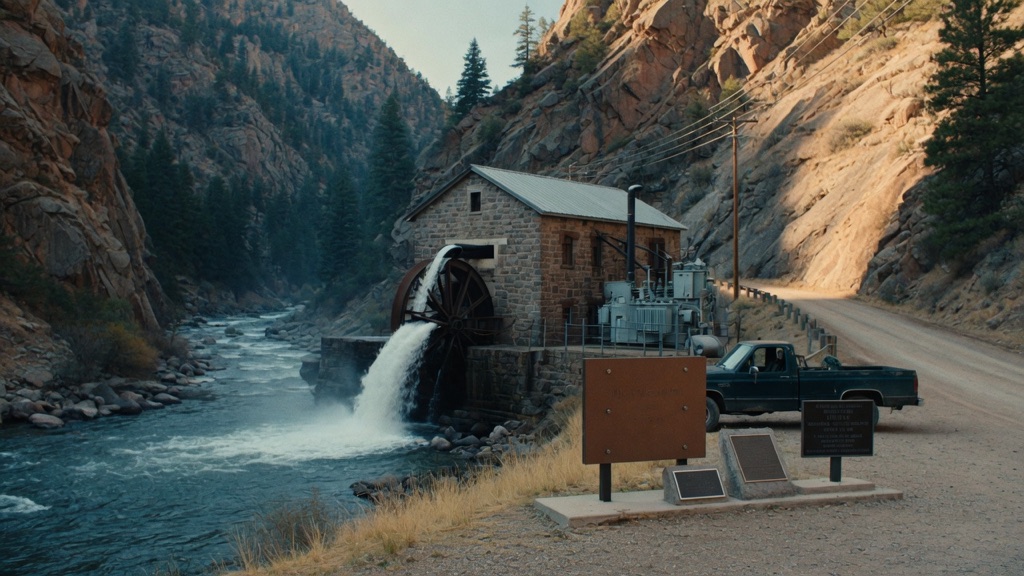
On June 19, 1891, a small stone powerhouse in a river canyon outside Ophir made electrical history: L.L. Nunn and a team of Westinghouse engineers flipped the switch on the world's first commercial AC power plant, transmitting 3,000-volt electricity 2.6 miles up a mountain to the Gold King Mine at a fraction of the cost Edison's DC technology would have required. The system — two 100-horsepower Westinghouse alternators driven by a Pelton wheel under 320 feet of water head — proved that Tesla's alternating current could beat direct current across rugged terrain. Xcel Energy still generates power here today from the 1905 powerhouse, making it one of the oldest continuously operating hydroelectric facilities in the country. Three commemorative plaques, including an IEEE Milestone marker, stand roadside beside the humming transformers.
→ Three more weird outdoor & roadside oddities in Durango — never the same twice
The story
In the late 1880s, Thomas Edison insisted direct current was the only logical way to electrify America—a strategy that worked fine until you needed to push power more than a mile up an 11,000-foot mountain. Over at the Gold King Mine, manager Lucien Lucius Nunn was bleeding cash trying to haul coal up treacherous San Juan trails. Edison’s DC systems couldn't bridge the distance without massive voltage drops. So Nunn ignored the New York establishment, teamed up with George Westinghouse, and bet his entire operation on Nikola Tesla’s high-risk, unproven alternating current technology.
On June 19, 1891, engineers flipped the switch at a stone shed at the confluence of the Howard Fork and the San Miguel River. Water dropped down a pipe under 320 feet of pressure head, spinning a Pelton wheel connected to two 100-horsepower Westinghouse alternators. The plant shot 3,000 volts of alternating current 2.6 miles up the ridge directly to the mine. It worked instantly, cutting Gold King's energy costs from thousands a month to pennies on the dollar. The fierce, high-stakes War of the Currents wasn't settled in a Manhattan boardroom—it was won right here in a damp mountain canyon.
The original 1891 stone building was eventually replaced in 1905 by the current brick-and-stone structure, but the site's trick hasn't stopped. Operated today by Xcel Energy, Ames remains one of the oldest continuously operating hydroelectric power plants on Earth. You are looking at a living piece of 19th-century infrastructure still quietly feeding watts into the modern grid.
What it's like
Don't expect a visitor center, a velvet rope, or a docent selling postcards. You reach the plant by driving down County Road 63L (Ilium Road) into a narrow canyon where the pavement gives way to gravel. You'll pull off onto the dirt shoulder right beside the fence line. The plant is a working industrial facility, so you view it strictly from the outside. Listen closely and you’ll hear the heavy, low-frequency hum of active transformers competing with the rushing water of Howard Fork. Read the roadside IEEE Milestone plaque, take in the high-voltage warnings, and appreciate the weird reality that this humble canyon nook essentially birthed the grid that powers your life.
The move: Park on the gravel shoulder, read the IEEE Milestone plaque together, and let the absurdity land: this quietly chugging river-canyon building is why your phone charges. Then drive the Ilium Road loop through the canyon for a scenic payoff on the way out.
📍 Before you go The plant is a working industrial facility — you view it from roadside, not inside. Access is via a maintained gravel road (County Road 63L off CO-145); a standard passenger car is fine in dry conditions, but check road conditions before visiting in winter or after storms. No admission fee, no formal parking lot — pull off on the shoulder. From Durango, allow roughly 1.5 hours each way via US-550 and CO-145 through Lizard Head Pass. The drive itself through the canyon is part of the experience.
- 📍 Ophir / Telluride
- 💸 Free
- ⚡ Up for anything
- 🌗 Outdoors
Where: Ames Road (County Road 63L), approximately 5 miles west of Telluride via CO-145; turn south at the Ilium Road junction. The plant sits at the end of the canyon road near the Howard Fork confluence. GPS approx. 37.8647°N, 107.8820°W.
Hours: Added 2026-06-11 — confirm current hours before you go.
Pair it with
- Alta Ghost Town — Alta is the high-altitude mining site that received the world's first long-distance AC power output generated down at Ames in 1891.
- Ophir Town & Post Office — Located just up the valley, this isolated mountain settlement gives immediate context to the extreme terrain the early electrical lines had to cross.
- Telluride Historical Museum — Head into Telluride afterward to see physical artifacts and deeper exhibits detailing L.L. Nunn's industrial experiments in the San Juans.
More weird in Durango

Good to know
Can you go inside the Ames Hydroelectric Plant?
No. It is an active, high-voltage power generation facility operated by Xcel Energy and is closed to the public. You view the facility and read the historical plaques from the roadside.
How do I get there from Telluride or Durango?
From Telluride, drive about 5 miles west on CO-145, turn south onto Ilium Road (County Road 63L), and follow the gravel canyon road down toward Ophir. From Durango, take US-550 North to CO-145 over Lizard Head Pass, then turn onto Ilium Road.
Do I need a 4WD vehicle to visit?
In dry summer conditions, County Road 63L is a maintained gravel road accessible by standard passenger cars. However, winter snow or heavy rainstorms can make the canyon roads hazardous, so check local weather and road conditions beforehand.
Is there an admission fee?
No. Viewing the plant from the public roadside shoulder is completely free.
Plan a visit & invite your people →
Further reading: Wikipedia · ethw.org · dcasler.com · telluride.com · renewableenergyworld.com
last checked: 2026-06-11