Entry No. 21 — the Detroit file — filed under: outdoor art
The Heidelberg Project
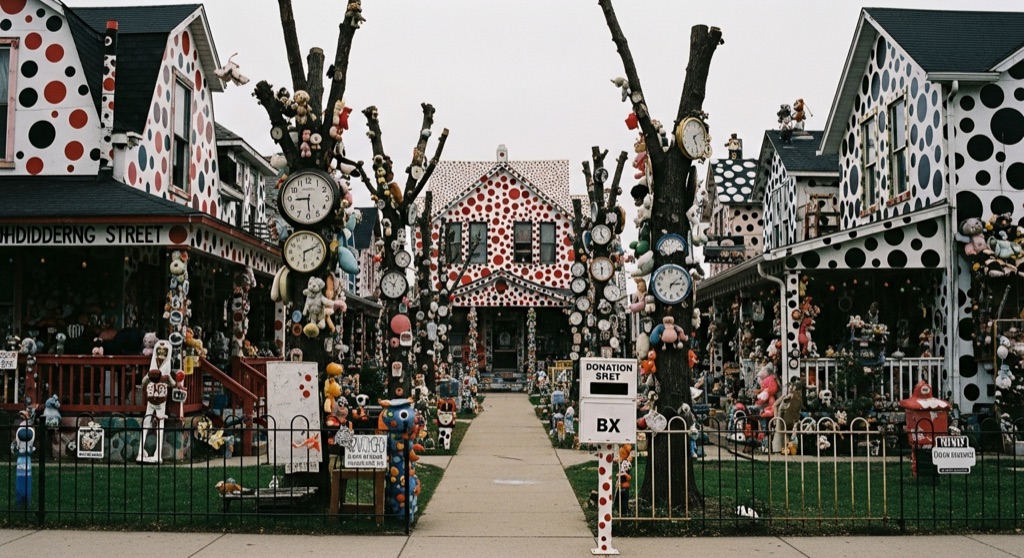
Detroit's most famous outdoor community art environment, started in 1986 by artist Tyree Guyton as a political protest against urban decay. It transforms a two-block neighborhood into a surreal, open-air gallery of polka-dotted houses, stuffed animals, and salvaged objects.
→ Three more weird outdoor & roadside oddities in Detroit — never the same twice
The story
In 1986, artist Tyree Guyton returned to Heidelberg Street—the McDougall-Hunt block on Detroit's East Side where he grew up—and found a neighborhood hollowed out by neglect and urban decay. Instead of watching it disappear, Guyton picked up a paintbrush and picked up the trash. He began salvaging discarded materials from around the city and attaching them to the abandoned structures, trees, and pavement along his childhood street, turning forgotten blight into an impossible-to-ignore visual manifesto.
What started as a solitary, raw act of political protest evolved into a surrealist, two-block open-air art installation. Salvaged shoes, upside-down lawn mowers, plush toys, and trees nailed with hundreds of wall clocks crowd the yards, anchored by iconic painted structures like the Dot House. Operating through a non-profit community organization, Guyton transformed a neglected neighborhood into a globally recognized monument to grassroots reclamation and creative resistance.
What it's like
You drive into a standard East Side residential neighborhood and suddenly the pavement dissolves into a vibrant, hallucinatory canvas of vinyl records, clock trees, and giant painted circles. Visiting is simply a matter of strolling down Heidelberg Street during daylight hours to take in the sprawling details at your own pace. It is an active, open outdoor environment located in a residential area, so keep your voice down, respect the residents, and make sure to drop cash into the on-site donation box to support the project's local youth and community art initiatives.
The move: Stroll down Heidelberg Street to spot the iconic 'Dot House' and the clock-covered trees, making sure to leave a small donation in the donation box to support the project's community programs.
- 📍 McDougall-Hunt
- 💸 Free
- ⚡ Up for anything
- 🌗 Outdoors
Where: 3600 Heidelberg St, Detroit, MI 48207
Hours: Added 2026-07-21 — confirm current hours before you go.
Pair it with
- Elmwood Cemetery — Pair an open-air neighborhood art environment with a quiet walk through Detroit's oldest non-denominational cemetery, less than a mile away.
- William V. Banks Broadcast Museum & Media Center — Follow up East Side public reclamation art with a visit to the historic studio of WGPR-TV62, the nation's first Black-owned television station.
- Beth Olem Cemetery — Continue the theme of Detroit's reclaimed land by hunting down an 1860s Jewish cemetery hidden inside a working General Motors plant.
More weird in Detroit
Good to know
How much does it cost to see the Heidelberg Project?
Wandering the outdoor street installation is free, though dropping a small contribution into the on-site donation box directly supports their community programs.
Where is it located?
The installation spans a two-block stretch centered around 3600 Heidelberg Street in Detroit's McDougall-Hunt neighborhood on the East Side.
Who created the Heidelberg Project?
Detroit artist Tyree Guyton founded the project in 1986 on the street where he grew up as an artistic protest against urban decay.
What are the hours?
It is an outdoor environment viewable during daylight hours, but you should confirm current visiting guidelines or organized tour schedules on their official site before visiting.
Plan a visit & invite your people →
Further reading: Official site · Atlas Obscura · Wikipedia
last checked: 2026-07-21