Entry No. 78 — the Des Moines file — filed under: after-dark
Iowa Star Party at Whiterock Conservancy
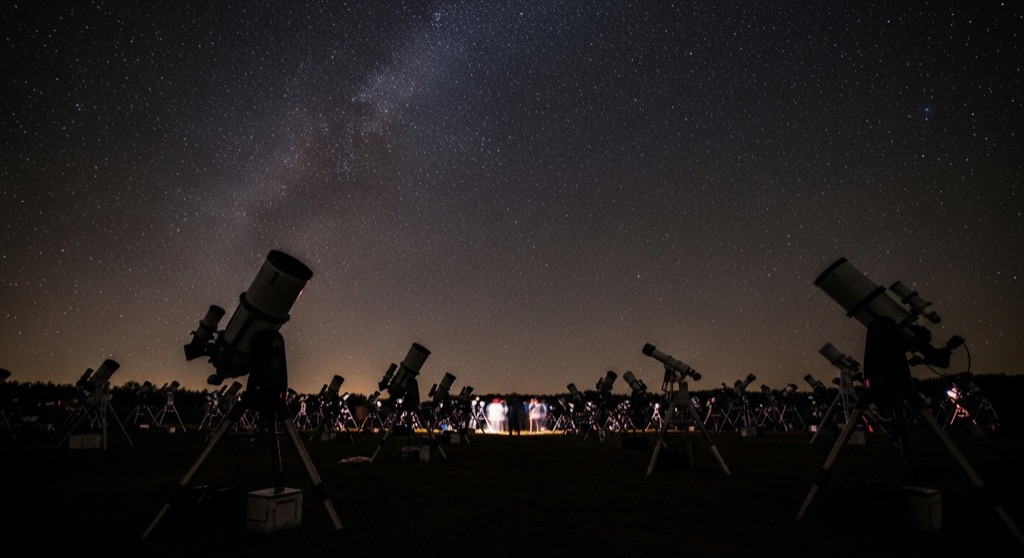
Whiterock Conservancy is a 5,500-acre nonprofit land trust along seven miles of the Middle Raccoon River valley, with some of the darkest skies in Iowa thanks to its distance from city lights and Coon Rapids' dark-sky-compliant lighting ordinance. Each fall the Ames Area Amateur Astronomers and Des Moines Astronomical Society host the multi-night Iowa Star Party here, and there's a free public viewing night where you can wander among dozens of telescopes after a short intro to the sky. On a clear night you can actually see the Milky Way arc overhead, plus galaxies, nebulae, and planets through the assembled scopes.
→ Three more after-dark & night-sky spots in Des Moines — never the same twice
The story
Drive eighty miles west of Des Moines until the glow of interstates dissolves completely into 5,500 acres of oak savannas and river valley. Whiterock Conservancy exists in a geographic sweet spot along seven miles of the Middle Raccoon River, but its real secret weapon isn't just distance—it's municipal policy. The nearby town of Coon Rapids specifically passed a dark-sky-compliant lighting ordinance to keep light pollution from bleeding into this corridor, turning the Conservancy's dedicated Star Field at 1523 140th Street into one of the darkest patches of turf in the state.
Every fall, the Ames Area Amateur Astronomers and the Des Moines Astronomical Society haul heavy optics out to the turf for the multi-night Iowa Star Party. While hardcore astrophotographers pay for full multi-day registrations to camp beside custom Dobsonian rigs, they carve out a single free public night for everyone else. You show up at dusk, catch a short orientation to the evening sky, and then step onto a pitch-black prairie where dozens of astronomers stand ready to point serious glass at things millions of light-years out.
What it's like
Expect a strict light-discipline protocol the second you approach the field. You park under dim lights and walk toward a dark prairie punctuated only by low voices and red LED glows—white phone screens and standard flashlights are strictly taboo because they ruin night-vision adaptation. After a quick intro talk, you wander freely from scope to scope across the grass. The owners are eager to dial in eyepieces so you can look directly at Saturn's rings, glowing nebulae, and spiral galaxies, while the unassisted Milky Way arcs clearly across the dark overhead. Bring serious warm layers—October night air on an open prairie cools fast—and bring a red flashlight or red cellophane to wrap over a standard torch.
The move: Make the drive out for the free public night, listen to the short sky orientation, then walk the dark Star Field looking through stranger after stranger's telescope at galaxies and the Milky Way.
📍 Before you go The Iowa Star Party is a once-a-year fall event (2026 dates around early-mid October) with a designated free public viewing night; weather-dependent and multi-day registration applies for the full party. Roughly 80 miles / 1h20m from Des Moines. Bring a red flashlight and warm layers.
- 📍 Coon Rapids, Carroll/Guthrie County
- 💸 $
- ⚡ Low-key
- 🌗 Outdoors
Where: Whiterock Conservancy Star Field, 1523 140th St, Coon Rapids, IA 50058
Hours: Added 2026-06-23 — confirm current hours before you go.
⚠ Seasonal or scheduled — always check before you go.
Pair it with
- Fjord Færgemand (Dambo Troll) — Stop in nearby Elk Horn on your drive west to see a 25-foot wooden troll sitting in a boat before heading north for dark skies.
- Kate Shelley High Bridge — Pair the vast open sky with an imposing industrial structure by viewing this 185-foot-tall railway viaduct on your route through Boone County.
- High Trestle Trail Bridge — Combine two open-air after-dark sights by walking the lit geometric steel tunnel of the High Trestle bridge on the same night-sky outing.
More weird in Des Moines
Good to know
Do I need a ticket or registration for the public night?
No. While full multi-day star party participants register and pay, the designated public viewing night is completely free with no registration required.
Why is white light prohibited on the field?
White light instantly resets human night vision, which takes up to thirty minutes to recover, and ruins long-exposure camera shots. Red light preserves night adaptation for everyone on the field.
How far is the Star Field from Des Moines?
It is approximately 80 miles west of Des Moines in Carroll and Guthrie counties, roughly an hour and twenty minutes by car.
What happens if there is heavy cloud cover or rain?
Telescope viewing is strictly weather-dependent. Check for weather status updates from the hosting astronomy clubs or Whiterock Conservancy before making the drive out.
Plan a visit & invite your people →
Further reading: Official site · Wikipedia · skyandtelescope.org
last checked: 2026-06-23