Entry No. 20 — the Denver file — filed under: hidden-landmark
The Shakespeare Elm
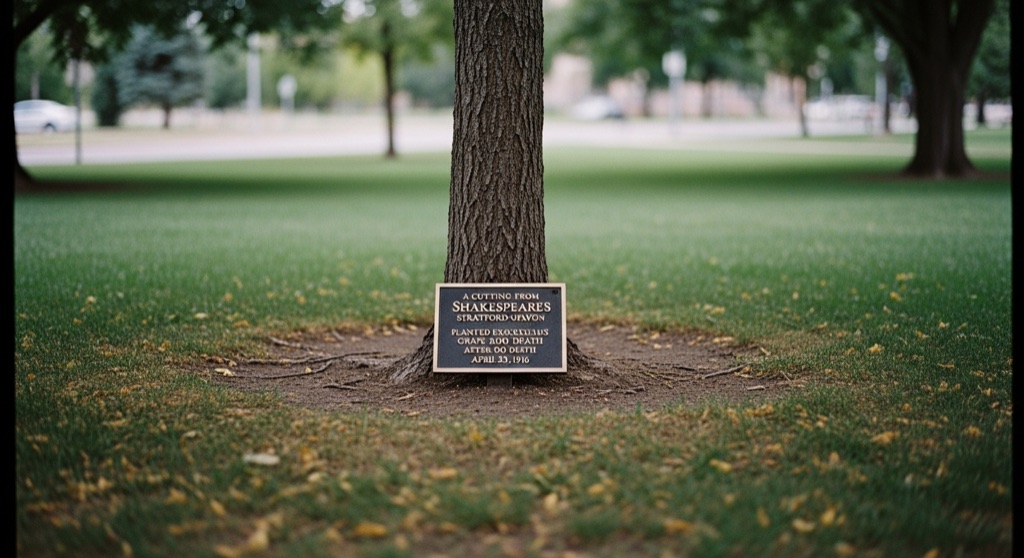
In the southeast corner of City Park stands an ordinary-looking elm that is secretly a piece of Shakespeare. It was planted on April 23, 1916, exactly 300 years to the day after the playwright died, grown from a cutting taken off the elm at his grave in Stratford-upon-Avon. A small bronze plaque at the base is the only thing marking it, so thousands of joggers and dog-walkers pass it every week with no idea what it is. It has outlived the Dutch elm disease that killed most of its neighbors.
→ Three more oddity shops & curiosities in Denver — never the same twice
The story
On April 23, 1916—exactly 300 years to the day after William Shakespeare died in Stratford-upon-Avon—Denver's supervisor of parks, John Russell, pushed a small tree cutting into the dirt at the southeast corner of City Park. That cutting wasn't local nursery stock; it was a scion taken directly from the wych elm hanging over the playwright's grave at Holy Trinity Church in England.
Decades later, Dutch elm disease tore through Denver's urban forest, killing off vast stretches of the city's shade trees. Somehow, this foreign clone survived the blight while its contemporaries withered, maturing into a broad canopy tree in the middle of what is now the City Park Arboretum.
You could drive past it along 17th Avenue Parkway or Colorado Boulevard every day without suspecting a thing. There are no iron fences, no towering markers, and no informational kiosks—just a small, low-mounted bronze plaque screwed into the base of the trunk that lets you in on the secret while thousands of oblivious joggers pass by.
What it's like
Finding the tree takes a bit of slow scanning along the grassy southeast corner of City Park, near 17th Avenue Parkway and Colorado Boulevard. Don't look for signs or manicured garden borders; you are hunting for a low bronze plaque at the foot of an unremarkable-looking trunk. Visit between late spring and autumn when the canopy is leafed out—bare winter branches make it impossible to tell apart from neighboring trees. Because it sits on open public ground, visiting is entirely free, self-guided, and accessible during standard park operating hours.
The move: Make a low-stakes scavenger hunt of it: hunt down the unmarked tree near 17th & Colorado Blvd using only the plaque clue, then sit under it and read each other a sonnet off your phone before walking deeper into the park.
📍 Before you go It hides in the southeast corner of City Park, roughly off E 17th Ave near Colorado Blvd — there's no signage beyond a low bronze plaque at the base, so treat finding it as the challenge and scan the trunks rather than looking for a marker. Go leaf-on, spring through fall, when the canopy actually reads as a tree worth the trip; bare winter branches make it easy to walk right past. It's free, open, and shared with joggers and dog-walkers, so you're on public ground. City Park is vast: pair the hunt with Ferril Lake's skyline-and-mountains view or the Denver Museum of Nature & Science along the park's east edge. Hours shift seasonally — check ahead.
- 📍 City Park
- 💸 Free
- ⚡ Low-key
- 🌗 Outdoors
Where: Southeast corner of City Park, near E 17th Ave & Colorado Blvd, Denver, CO 80205 (look for the small plaque at the base)
Hours: Outdoors in a public park; accessible during park hours (roughly dawn to 11pm). Easiest to find leaf-on, spring through fall.
Pair it with
- Park Hill Treasures — Continue east along the Colfax corridor to trade hunting for hidden trees for sifting through vendor stalls set inside an old bank vault.
- The Learned Lemur — Pair an obscure living plant relic with a Victorian home full of ethically sourced taxidermy and curiosities further west on East Colfax.
- Crawford Hotel Lost & Found Wall — Head downtown to Union Station to match a century-old imported tree cutting with a collection of historic personal items pulled from train depot benches.
More weird in Denver



Good to know
Where in City Park is the Shakespeare Elm located?
It stands in the far southeast corner of City Park, near East 17th Avenue Parkway and Colorado Boulevard, close to the edge of the Denver Museum of Nature & Science grounds.
How do I know I've found the right tree?
Check near the base of the trunk for a low bronze plaque stating that the scion was taken from the tree at Shakespeare's grave in Stratford-upon-Avon and planted on April 23, 1916.
Is there an admission fee or set tour time?
No, it is located on open public park land, so it is free to visit whenever City Park is open (roughly dawn to 11 p.m.).
When is the best season to look for it?
Spring through fall, when the tree is full of leaves and distinguishable as part of the park's living canopy.
Plan a visit & invite your people →
Further reading: Westword · denverbyfoot.com · kdvr.com · Wikipedia · denvercenter.org
last checked: 2026-06-07