Entry No. 225 — the Denver file — filed under: ruins
The Birch Ruins
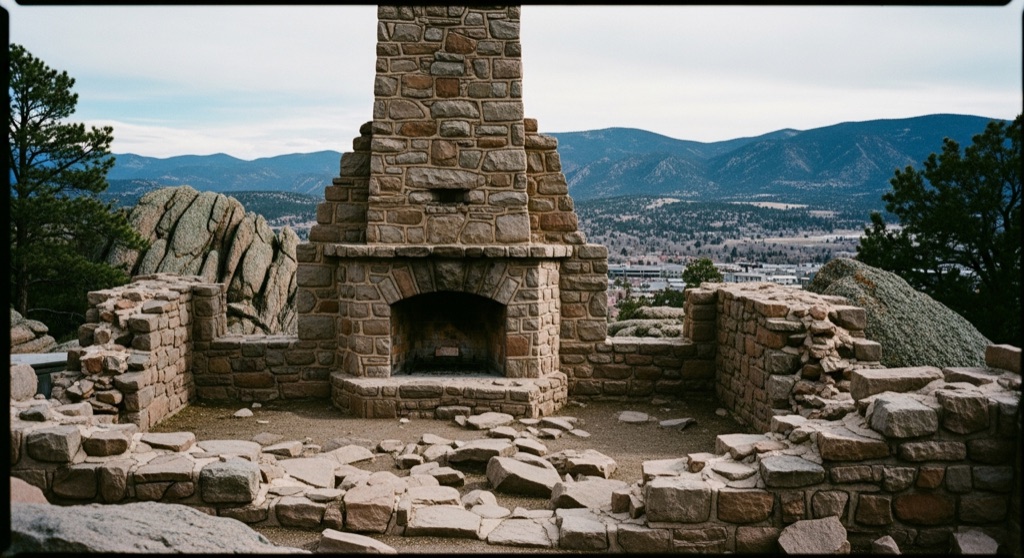
Perched on a rocky outcropping in the Knoll-Willows Open Space, these stone ruins are all that remain of a bungalow built for Denver Post editor Albert Birch in 1904. The home, originally named 'Jacob's Ladder' due to its steep climb, was destroyed by a devastating fire on a freezing night in December 1907. Today, only the rugged stone walls and a massive fireplace remain, offering a haunting look at early 20th-century mountain living alongside panoramic views of Estes Park.
→ Three more abandoned & forgotten places in Denver — never the same twice
The story
In 1904, Denver Post editor Albert Birch hired local stonemason Carl Piltz to construct a summer bungalow high on a granite outcropping above what was then just a quiet scattering of mountain ranches. Birch dubbed the house 'Jacob’s Ladder' because getting up to it required a steep, grueling climb up the knoll. From his wraparound porch, he got a direct, unobstructed line of sight straight toward Longs Peak and the valley floor. He got three summers out of it.
On a freezing night in December 1907, fire swept through the structure and gutted the wooden interior. Piltz’s rugged stonework, however, refused to collapse. Instead of trying to rebuild on the exposed crest, Birch put up a modest log cabin down at the foot of the hill in 1908 and left the scorched stone shell standing on the ridge like an open-air frame.
The Birch family held onto the knoll and the lower cabin into the 1980s before the Town of Estes Park acquired the parcel to form the Knoll-Willows Open Space. Today, you can step inside the roofless stone hearth, lean against the surviving chimney masonry, and look straight down at the bumper-to-bumper tourist traffic on Elkhorn Avenue without anyone on the main drag even noticing you're up there.
What it's like
Finding the trailhead requires zero wilderness survival skills: park near the Estes Valley Public Library or Town Hall off MacGregor Avenue and walk behind the buildings into the Knoll-Willows Open Space. You'll cross a small footbridge over Black Canyon Creek, pass Birch's 1908 lower log cabin, and take a quick, gravelly 0.4-mile loop up the switchbacks. The trail is short, unshaded, and rocky underfoot, but while tourists line up for hours to get into Rocky Mountain National Park, you'll likely have this hilltop perch and its sweeping mountain panorama entirely to yourself.
The move: Take a scenic 0.4-mile loop hike up the Knoll-Willows trail to photograph the historic stone fireplace and enjoy panoramic views of downtown Estes Park and the surrounding Rocky Mountains.
📍 Before you go The ruins are located within the Knoll-Willows Open Space, which is owned by the Town of Estes Park and open to the public via a short, maintained hiking trail.
- 📍 Estes Park
- 💸 Free
- ⚡ Low-key
- 🌗 Outdoors
Where: 300-396 MacGregor Ave, Estes Park, CO 80517, USA
Hours: Added 2026-07-20 — confirm current access before you go.
Pair it with
- Seven Keys Lodge Key Room (formerly Baldpate Inn) — Pair a quick hike to early 1900s stone ruins with a five-mile drive to a historic mountain lodge holding a room crammed with over 20,000 global keys.
- Sleepy Lion Trail to Button Rock Dam — Trade the overlook above downtown Estes Park for a quiet, low-traffic trail down US-36 near Lyons that leads out to a secluded stone dam.
- Lyons Memorial Labyrinth — Follow up an open-air stone hearth on a knoll with a contemplative walking labyrinth built out of flood-borne river cobbles down in Lyons.
- Faces Bridge — Contrast an elevated hilltop ruin in the mountains with an under-bridge riverwalk in Loveland lined with dozens of bronze faces.
More weird in Denver



Good to know
How do you reach the Birch Ruins?
Park along MacGregor Avenue or near the town library, then follow the 0.4-mile roundtrip trail through the Knoll-Willows Open Space located directly behind Town Hall.
Does visiting cost anything?
No, the Knoll-Willows Open Space is owned by the Town of Estes Park and open to the public free of charge.
What parts of the original bungalow are still standing?
Only the sturdy exterior stone walls and the massive central fireplace constructed by stonemason Carl Piltz survived the December 1907 fire.
What is the wooden cabin near the base of the trail?
That is the rustic log cabin Albert Birch built in 1908 after his original stone home burned down; his family used it as a summer retreat until the 1980s.
Plan a visit & invite your people →
Further reading: Atlas Obscura · historycolorado.org
last checked: 2026-07-20