Entry No. 61 — the Dallas file — filed under: fossil-hunting
Mineral Wells Fossil Park
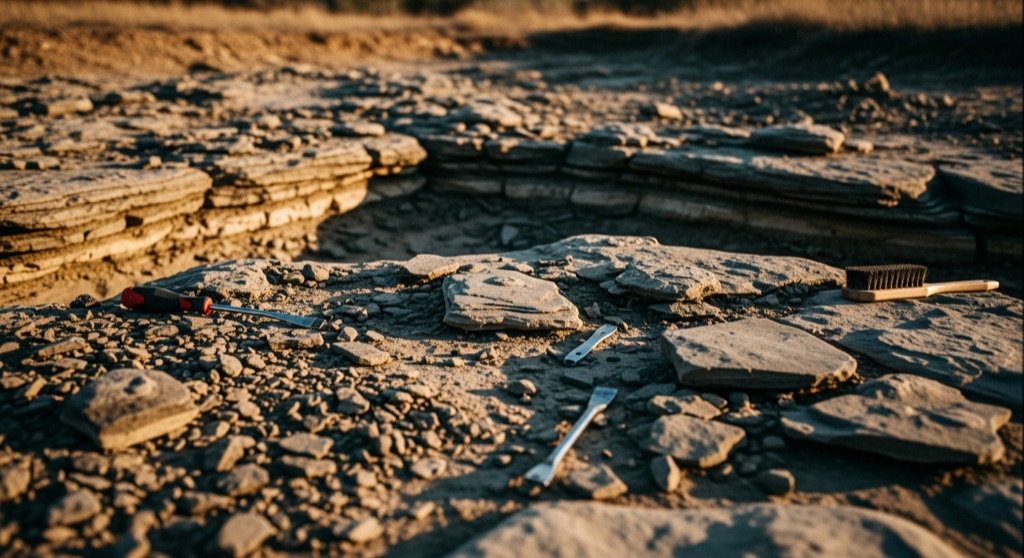
What was once the City of Mineral Wells' landfill borrow pit turned out to be something far stranger: twenty-plus years of erosion peeled back the topsoil and exposed a 300-million-year-old Pennsylvanian sea floor sitting quietly in the Texas scrub. This free municipal park is one of the very few places in the US where you can legally dig up fossils — shark teeth, trilobites, crinoids, brachiopods, echinoids — and walk away with them in your pocket, no permit required. It's listed on Atlas Obscura and covered by Roadside America, which should tell you everything about its vibe. An hour west of Fort Worth, it gets almost none of the foot traffic it deserves, which means the shale is still genuinely productive for a patient digger.
→ Three more weird outdoor & roadside oddities in Dallas — never the same twice
The story
In the early 1990s, the City of Mineral Wells closed a municipal landfill borrow pit on the northwest edge of town and left it alone. They thought they were done with it. But wind and heavy North Texas rain spent the next twenty years stripping off the topsoil, exposing an eight-acre dirt basin that turned out to be a 300-million-year-old Pennsylvanian seabed. Long before Texas was prairie, it was covered by a shallow ocean teeming with crinoids, echinoids, and primitive sharks—and the earth peeled itself open to hand it back.
Instead of fencing off the site or locking the specimens behind museum glass, the city teamed up with the Dallas Paleontological Society to open the pit as a free public park. It remains one of the absurdly rare places in the country where you can spend an afternoon on your knees, pry 300-million-year-old sea lily stems out of soft shale with a flat-head screwdriver, and walk away with them in your pocket. No permits, no park ranger watching over your shoulder, no catch—just leave the heavy machinery at home.
Because the pit is a living erosion site, every severe thunderstorm flips the terrain and washes fresh fossils right out of the matrix. You aren't digging through picked-over river gravel. The grey shale is packed tight with crinoid columnals—locals call them 'Indian beads'—alongside bryozoans, petrified coral, and tiny shelled brachiopods. If you're patient enough to crawl along the clay, you might uncover a whole trilobite or the blunt, grinding tooth of a Pennsylvanian-era shark.
What it's like
You’ll pull off Indian Creek Road into a quiet gravel parking area that feels more like an industrial site than a municipal park. Walk past the shaded pavilion and head down the handrailed embankment into the exposed grey dirt bowl—and immediately get down low. Standing up gets you nothing here; the secret is crawling across a single square foot of shale at a time. Bring a flat-head screwdriver, a soft brush, knee pads or a kneeling mat, and zip-top plastic bags to organize your haul. There is zero running water and virtually no shade down in the pit, so pack gallon jugs of water and wear a wide-brim hat. Go early in the morning right after a heavy rainstorm, when runoff has swept away loose silt and left freshly exposed fossils sitting right on the surface.
The move: Pack a couple of flat-head screwdrivers and a brush, show up early before the Texas heat peaks, and spend a few hours cracking open shale layers in search of 300-million-year-old sea creatures — then argue over whose crinoid stem is more impressive on the drive back.
📍 Before you go It's tucked northwest of town: from US-180, turn north onto Indian Creek Road and follow it a couple of miles to the lot. From there a short trail leads past a shaded canopy and down a gentle, handrailed embankment into the old borrow pit — that gravel bowl is the dig site. Surface-collecting only, with small hand tools; come right after a good rain, when runoff resurfaces fresh fossils, and arrive early, as there's almost no shade. Facilities are primitive with no running water, so pack plenty along with sun protection and knee pads. Lake Mineral Wells State Park, just east of town, makes an easy pairing.
- 📍 Mineral Wells
- 💸 Free
- ⚡ Up for anything
- 🌗 Outdoors
Where: 2375 Indian Creek Rd, Mineral Wells, TX 76067
Hours: Added 2026-06-09 — confirm current hours before you go.
Pair it with
- The Famous Mineral Water Company / Crazy Water Bar — After hours picking through dusty shale, head four and a half miles into town for a cold splash of Mineral Wells' famous lithium-laced 'Crazy Water'.
- Baker Hotel Ghost Walk — Wash off the pit dust and spend your evening circling the towering, long-abandoned 1929 Baker Hotel just under five miles away.
- Penitentiary Hollow, Lake Mineral Wells State Park — Trade grey shale beds for the 20-to-40-foot sandstone conglomerate cliffs inside Lake Mineral Wells State Park, less than ten miles east.
More weird in Dallas

Good to know
Is admission really free, and can I keep what I find?
Yes. Admission is completely free, and city rules explicitly allow visitors to collect fossils and keep them for personal, non-commercial use.
What tools am I allowed to bring?
Only small hand tools are permitted. Garden trowels, screwdrivers, brushes, knee pads, and small ziplock bags are fine. Shovels, pickaxes, and power tools are strictly forbidden.
When is the best time to go fossil hunting?
Plan your trip a day or two after a rainstorm, which washes away topsoil and reveals fresh fossils. Arrive early in the morning before the Texas sun heats up the unshaded pit.
Are there restrooms or drinking water on site?
Facilities are primitive. There is no running water at the park, so bring plenty of drinking water, sunscreen, and hand sanitizer.
Plan a visit & invite your people →
Further reading: Official site · Atlas Obscura · Yelp · Tripadvisor · ksat.com
last checked: 2026-06-09