Entry No. 28 — the Columbus file — filed under: history
Westerville History Museum (Anti-Saloon League Museum)
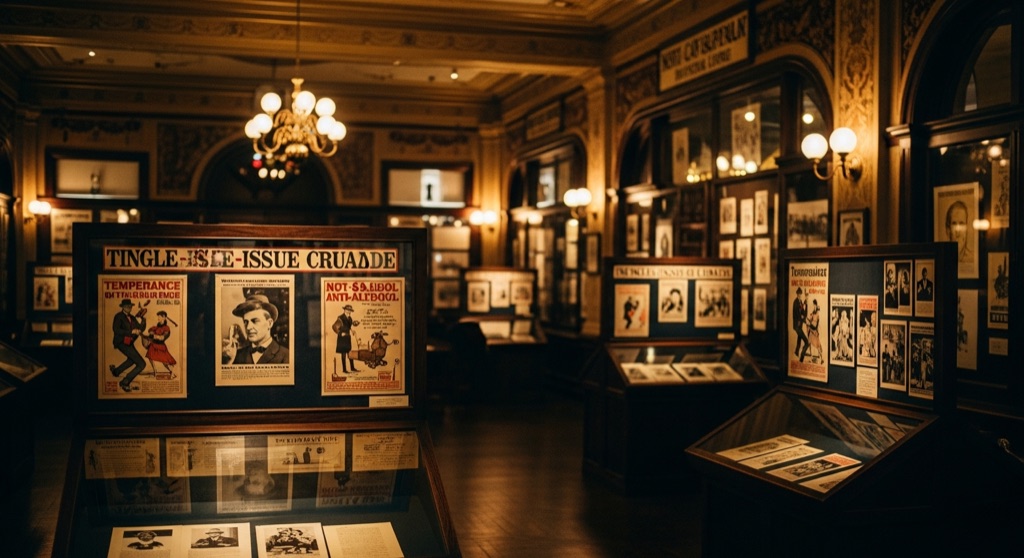
Located in the former 'Dry Capital of the World,' this museum documents the single-issue crusade of the Anti-Saloon League, which printed over 40 tons of prohibitionist propaganda per month here.
→ Three more hidden bars & speakeasies in Columbus — never the same twice
The story
Long before modern lobby groups perfected dark money and political coercion, a single-issue crusade operated out of a quiet suburb north of Columbus and systematically rewrote the U.S. Constitution. In 1909, the Anti-Saloon League relocated its national headquarters and its printing arm, the American Issue Publishing Company, to Westerville. The League didn't just preach temperance; it weaponized print media, cranking out over 40 tons of anti-alcohol pamphlets, periodicals, and moralizing cartoons every month. The torrent of propaganda was so relentless that tiny Westerville became the smallest town in America with a first-class post office.
The municipality's zeal wasn't accidental. Back in 1875 and 1879, a local businessman named Henry Corbin repeatedly tried opening saloons in town, triggering what locals called the 'Westerville Whiskey Wars'—a conflict that ended when dry vigilantes literally dynamited his establishments. When the League finally folded its local operation in 1973, it bequeathed its entire propaganda paper trail to the Westerville Public Library. Decades later, when filmmakers Ken Burns and Lynn Novick were assembling primary source material for their PBS documentary Prohibition, they spent time digging through these exact archives to find the original prints and political cartoons that engineered nationwide dry laws.
Today, the Westerville History Museum occupies the League's former headquarters right inside the public library, preserving the nerve center of the 18th Amendment. Westerville itself held onto its dry heritage fiercely, barring alcohol sales until 2005. Walking through the collection today isn't a stroll through generic local heritage; it's an encounter with ground zero of American political prohibitionism, where moral outrage was mass-produced on industrial steam presses.
What it's like
You'll head into the Westerville Public Library on State Street, slip past the book stacks, and enter what feels like a quiet, climate-controlled vault of historical agitation. The display cases are packed with vintage temperance pledge cards, anti-liquor comic strips, and authentic League office furniture. Admission is completely free, though you should mind the timing: the museum pauses operation between 1:00 PM and 2:00 PM on Saturdays and stays closed on Sundays. Take a minute to read the fine print on the century-old propaganda fliers; the sheer intensity of their political messaging puts modern campaign ads to shame.
The move: Browse through the collection of vintage temperance pamphlets, anti-alcohol cartoons, and historical photos that Ken Burns used as primary sources for his PBS Prohibition documentary.
- 📍 Westerville
- 💸 $
- ⚡ Up for anything
- 🌗 Indoors
Where: 110 S State St, Westerville, OH 43081
Hours: Added 2026-07-21 — confirm current hours before you go.
Pair it with
- P.O. Box Twenty One — Toast the irony of sipping a craft cocktail behind a fake mailroom door just two blocks away from the museum whose 40 monthly tons of temperance mail forced Westerville to get a first-class post office.
- The Doll Museum at the Old Rectory — Trade century-old political propaganda for a niche, hyper-specific collection of 19th-century French fashion dolls in nearby Worthington.
- Tranquility Salt Cave — Decompress from decades of aggressive political activism by unwinding inside a heated room lined with 10,000 pounds of imported Himalayan rock salt.
More weird in Columbus
Good to know
Where inside the building is the museum located?
It is housed inside the Westerville Public Library at 110 S State St, occupying the historic building attached to the library that served as the League's original headquarters.
How much does it cost to visit?
Admission is completely free, as the museum operates under the umbrella of the public library system.
What primary sources did Ken Burns use from this collection?
Ken Burns and Lynn Novick sourced vintage temperance pamphlets, anti-alcohol cartoons, and original photographs from the library's Anti-Saloon League archive for their 2011 PBS documentary Prohibition.
Why was Westerville called the 'Dry Capital of the World'?
The town earned the title after the Anti-Saloon League established its national headquarters and printing plant here in 1909, shipping 40 tons of dry literature monthly and keeping the town legally dry until 2005.
Plan a visit & invite your people →
Further reading: Official site · ohiomagazine.com
last checked: 2026-07-21