Entry No. 78 — the Colorado Springs file — filed under: after-dark
Rocky Mountain Star Stare (Starry Meadows)
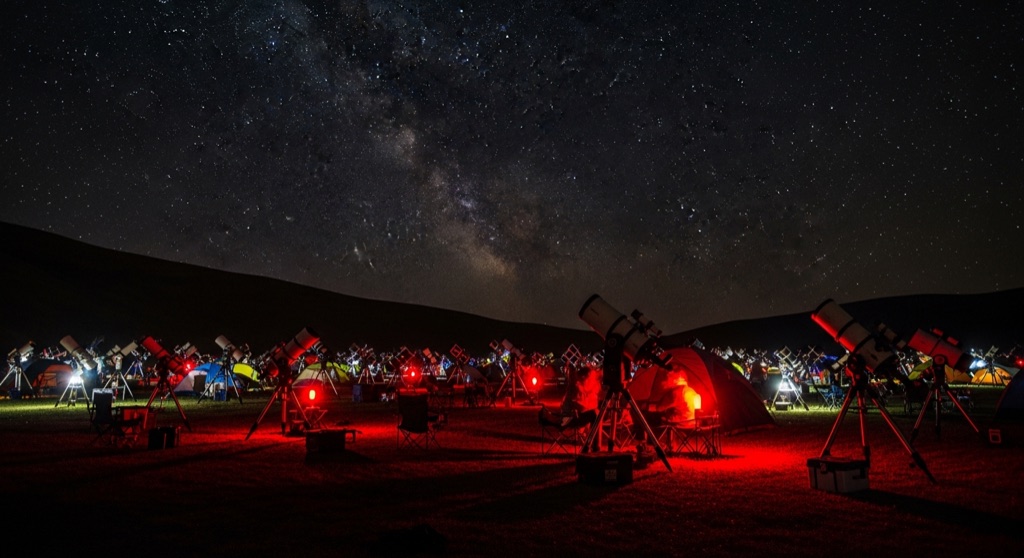
Once a year the astronomical society throws open its private 35-acre observing site, Starry Meadows, for a multi-night dark-sky campout at 7,600 feet where 300-plus amateur and pro astronomers haul in serious telescopes. At this altitude and isolation the sky is genuinely black, and the field becomes a glowing maze of red headlamps and gear after sunset. The 2026 event runs June 10-14.
→ Three more after-dark & night-sky spots in Colorado Springs — never the same twice
The story
Tucked into a high-elevation valley between the Sangre de Cristo and Wet Mountain ranges sits Starry Meadows, a private 35-acre swath of grass outside Gardner owned by the Colorado Springs Astronomical Society. Most of the year, it is an empty alpine pasture at 7,600 feet. But once a summer, the club unlocks the gate for the Rocky Mountain Star Stare, drawing more than 300 amateur and professional astronomers who haul in custom-built gear, trailer-mounted rigs, and massive Dobsonian telescopes.
The draw is atmospheric clarity and absolute darkness. At this altitude and remote location, urban light pollution is non-existent. As night falls, the open field transforms into a quiet, glowing grid of dim red headlamps, red-filtered laptop screens, and dark-adapted stargazers. Scope owners are typically eager to share the view, letting you step up a ladder to peer through high-end optics at deep-sky objects, nebulae, and galaxy clusters millions of light-years away.
What it's like
Expect a two-hour drive southwest from Colorado Springs onto rural roads, and bring a complete self-contained camping setup—there are no lodging facilities at the meadow. The vibe on the field is collaborative, quiet, and deeply technical. Daytime brings scheduled talks and vendor setups, but nighttime triggers strict dark-sky protocol: white flashlights, car headlights, and unshielded phone screens are strictly forbidden to protect night vision. Pack dim red headlamps, dress for freezing night temperatures, and walk carefully around the web of power cables on the grass.
The move: Camp out for a night, walk the field of giant telescopes after dark peering at deep-sky objects the owners are happy to show off, and crawl into the tent with the Milky Way still blazing overhead.
📍 Before you go Registration required; annual multi-day event (June 10-14, 2026). Roughly two-plus hours southwest of the Springs; bring your own camping setup.
- 📍 Gardner
- 💸 $
- ⚡ Low-key
- 🌗 Outdoors
Where: Starry Meadows, near Gardner, CO (between the Sangre de Cristo and Wet Mountain ranges)
Hours: Added 2026-06-23 — confirm current hours before you go.
⚠ Seasonal or scheduled — always check before you go.
Pair it with
- Silver Cliff Cemetery Ghost Lights — Pair your night of deep-sky stargazing with another dark-sky mystery 24 miles away in the Wet Mountain Valley, where unexplained blue-white lights have drifted through the cemetery since the 1880s.
- Hidden Peak Tiki Lounge — Grab a tropical cocktail in an underground tiki bar hidden beneath a feedstore in nearby Westcliffe before heading into the pitch-black prairie for stargazing.
- Bishop Castle — Stop by Jim Bishop's massive, hand-built stone castle in Rye for a daytime scramble up iron towers before driving down to Starry Meadows for sunset.
More weird in Colorado Springs
Good to know
When does the Rocky Mountain Star Stare take place?
It is an annual multi-night summer event. The 2026 star party runs from June 10 through June 14.
Can I show up and buy a ticket at the gate?
No. Advanced registration is required through the Colorado Springs Astronomical Society (rmss.org) before heading out.
What amenities are on site at Starry Meadows?
The 35-acre site includes portajohns and the Starry Meadows Town Hall building, but you must bring your own shelter, camping gear, food, and water.
What are the rules regarding lighting after dark?
White light of any kind is prohibited on the field after sunset. Attendees must use red-filtered lights or red headlamps to preserve dark adaptation for observing and astrophotography.
Plan a visit & invite your people →
Further reading: rmss.org · csastro.org
last checked: 2026-06-23