Entry No. 56 — the Colorado Springs file — filed under: miniature-diorama
Michael Garman Museum - Magic Town
“gritty Americana rendered in miniature, not a sanitized diorama”
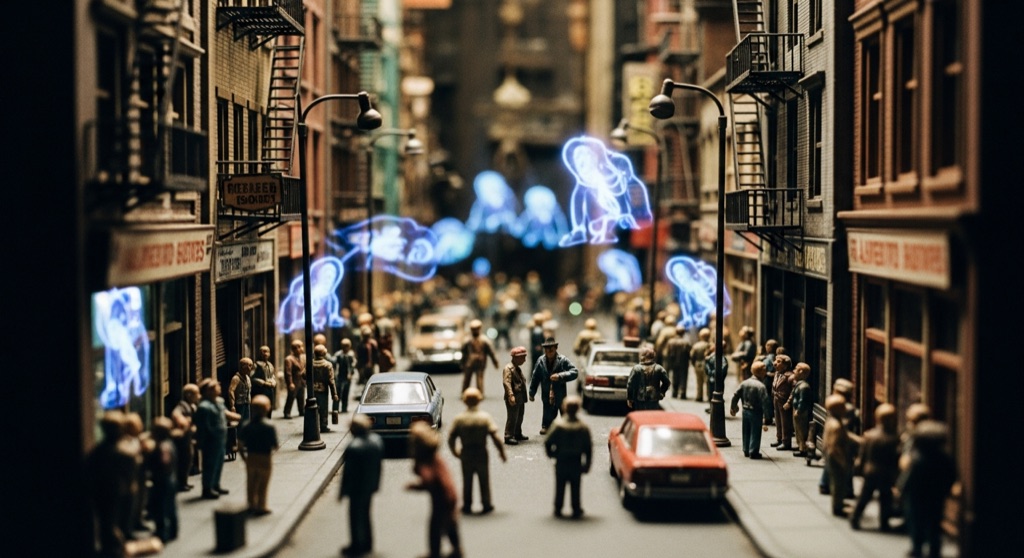
A 3,000-square-foot handcrafted miniature city by artist Michael Garman, packed with 400+ sculpted figures, dark alleys, and holograms that heckle passersby — gritty Americana rendered in miniature, not a sanitized diorama.
→ Three more unusual museums & collections in Colorado Springs — never the same twice
The story
You don't expect a 3,000-square-foot, mid-century urban underworld to be hiding behind a retail gift shop selling cast-resin firefighter statues, but that is precisely the trick. Before Michael Garman built Magic Town, he was a self-described vagabond who hitchhiked from Texas down through Mexico to Chile in the late 1950s, learning to sculpt after wandering into a Santiago fine arts school. When he settled in Colorado and began constructing his 1:6 scale city in 1975, he bypassed sanitized suburban scenes in favor of the gritty brownstones, fire escapes, pool halls, and tenement alleys of his travels.
This is an unfiltered slice of miniature Americana packed with over 400 hand-sculpted figures—card sharks, shopkeepers, vagrants, and alley dwellers. Garman rigged the entire installation with theater illusions: two-way mirrors that turn two-foot-deep boxes into seemingly infinite city blocks, timed lighting cycles that shift night to day, and Pepper's Ghost holograms that make brick walls dissolve into hidden passages. Stand in front of Ruthie's Café or the Crown Theater—which projects actual footage of Casablanca onto a microscopic screen—and projected miniature characters will suddenly appear in the windows and address you directly.
What it's like
From the sidewalk on West Colorado Avenue, the storefront reads like a standard art gallery. You have to walk past the retail displays of Garman's commercial sculptures to reach the darkened back room under the neon sign. Inside, the space is flat, compact, and dimly lit, though mirrored angles create the illusion of endless, winding streets. Grab the complimentary scavenger hunt sheet at the counter—it forces you to lean close and inspect window sills and fire escapes for hidden details. Because the lighting cycles, holograms, and sound vignettes operate on automated timers, linger at each block for a minute or two or you will miss entire scenes transforming right in front of you.
The move: Work the complimentary scavenger hunt together to find hidden details, and see who can get the most holograms to talk back.
📍 Before you go From the street it reads as a gift shop — Magic Town itself is a darkened room at the back, entered under a neon sign past the gallery of Garman's sculptures for sale. Park on the street or in one of the marked lots along West Colorado Avenue; inside it's flat, compact, and unhurried — budget a half hour or so. The lighting tricks and sound vignettes cycle on their own schedule, so linger at each block or you'll miss the brick wall dissolving into an alley. You're in the middle of Old Colorado City's historic shopping strip, so pair it with a slow wander past the storefronts.
- 📍 Old Colorado City
- 💸 $
- ⚡ Up for anything
- 🌗 Indoors
Where: 2418 W Colorado Avenue, Colorado Springs, CO 80904
Hours: Added 2026-06-09 — confirm current hours before you go.
Pair it with
- Old Colorado City History Center — Pair Garman’s gritty miniature mid-century city blocks with the real gold-rush saloons and wild history of Old Colorado City just down the street.
- MatchBox Candle Co. — Step out of Garman’s dim, holographic back alleys and walk a hundred yards down West Colorado Avenue to pour your own custom candle.
- 22nd Street Clay — After inspecting Garman’s hand-sculpted street figures up close, head half a mile west to get your own hands on some clay.
- Miramont Castle — Trade Garman’s 1:6 scale mid-century urban dioramas for a full-scale 1895 Victorian mansion built in nine distinct architectural styles.
More weird in Colorado Springs

Good to know
Where is Magic Town located within the building?
The exhibit is located in a darkened room at the very back of the Michael Garman Museum & Gallery, entered past the retail sculpture showroom.
How long should I budget for a visit?
Budget roughly 30 to 45 minutes to walk through the exhibit, though visitors who complete the entire scavenger hunt often stay longer.
How do the visual effects and holograms work?
Garman engineered the town using angled two-way mirrors, timed dimming lights, and Pepper's Ghost projection techniques that reflect hidden video feeds onto glass panels inside the dioramas.
Do I need to buy tickets or make reservations in advance?
No advance reservations are required for standard visits; you can purchase admission at the front counter inside the shop.
Plan a visit & invite your people →
Further reading: Official site · Atlas Obscura · Roadside America
last checked: 2026-06-09