Entry No. 39 — the Cincinnati file — filed under: observatory
Cincinnati Observatory
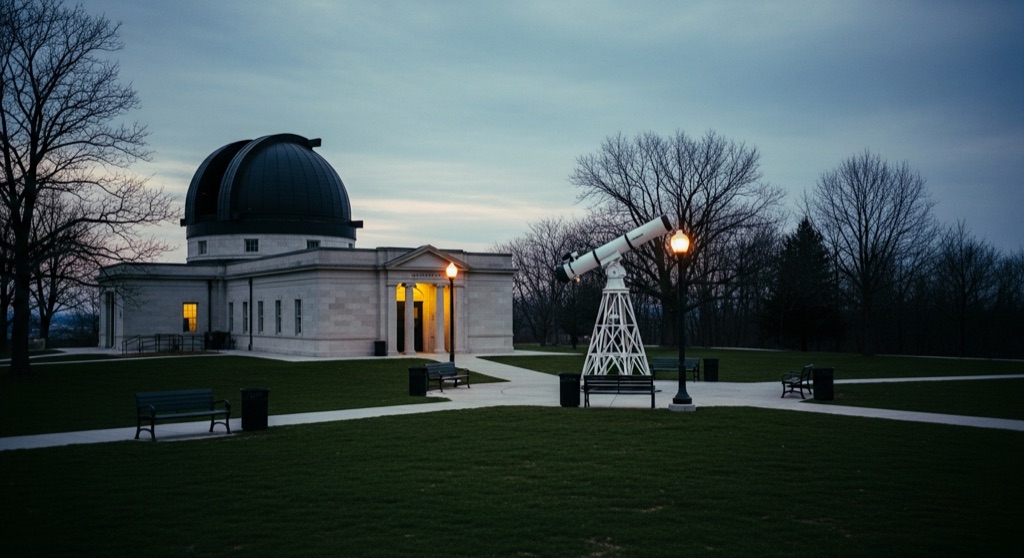
Known as the birthplace of American astronomy, this historic hilltop observatory houses the nation's oldest public telescope still in continuous operation.
→ Three at a time, never the same twice — explore weird Cincinnati
The story
In 1843, Cincinnati College professor Ormsby MacKnight Mitchel raised money by selling $25 shares to hundreds of local residents, then traveled to Munich to purchase an 11-inch refractor lens. He persuaded 76-year-old former President John Quincy Adams to endure a grueling, multi-week winter journey to lay the cornerstone on Mount Ida. Adams delivered his final public address at the ceremony, prompting city leaders to rename the hilltop Mount Adams on the spot. By 1873, downtown coal smoke made astronomical observations impossible, forcing the observatory to relocate further east to a higher, clearer ridge—giving birth to the neighborhood name Mount Lookout.
That relocation carried significant scientific history. Under director Cleveland Abbe in the late 1860s, the facility began collecting telegraphic weather reports to issue daily storm predictions—a project that earned Abbe the nickname 'Old Probs' and directly established the precursor to the National Weather Service. The observatory also functioned as the city's official timekeeper, regulating municipal clocks by tracking stellar transits across crosshairs. The 1873 Greek Revival main building was designed by architect Samuel Hannaford, featuring an early rotating roof mechanism that originally rolled on surplus Civil War cannonballs.
The site's real draw is that its historic instrumentation was preserved rather than replaced. Inside the 1904 Mitchel Building sits the original 1845 brass-and-wood Merz und Mahler refractor telescope. Hand-cranked and balanced with heavy iron counterweights, it remains the oldest public telescope in the Western Hemisphere still in continuous operation for nighttime viewing.
What it's like
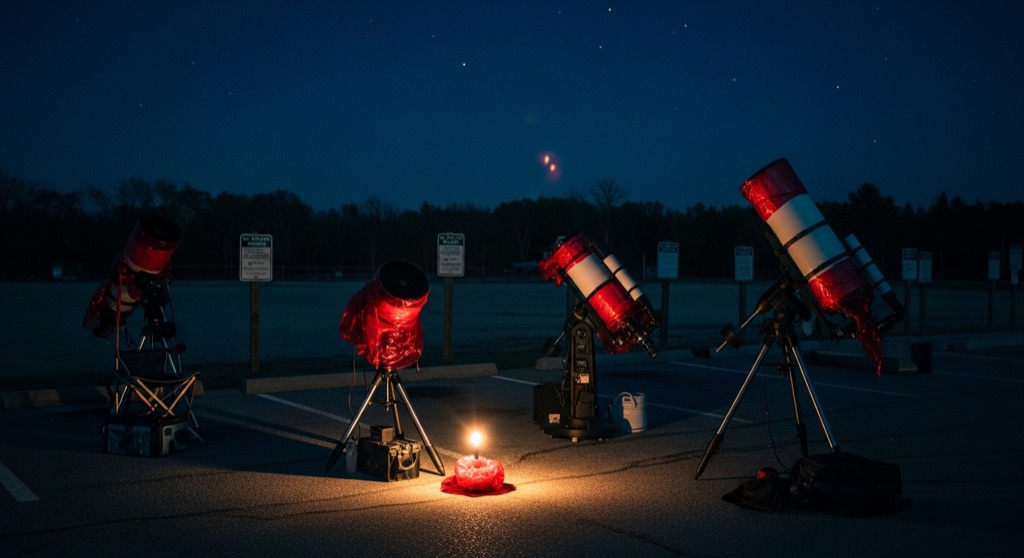
A visit feels like stepping inside a working Victorian lab, filled with heavy brass gears, dark woodwork, and hand-turned mechanisms. Because temperature changes warp optical glass, the dome rooms are unheated and un-air-conditioned to match the ambient air, so dress heavily in winter and lightly in summer. Expect to wait in line, climb a tall wooden step-ladder, and look through the eyepiece to view Saturn's rings, Jupiter, or lunar craters. Cloud cover and light pollution remain wildcards; if overcast weather blocks the sky, staff pivot event nights to historical talks, planetarium simulations, and behind-the-scenes dome tours.
The move: Reserve tickets for an Astronomy Evening to peer through the 1845 Mitchel brass refractor telescope at Saturn's rings or lunar craters, then stroll the quiet hilltop park grounds.
- 📍 Mount Lookout, Cincinnati, OH
- 💸 $
- ⚡ Low-key
- 🌗 Outdoors
Where: 3489 Observatory Pl, Cincinnati, OH 45208
Hours: Added 2026-07-21 — confirm current hours before you go.
Pair it with
- The Cincinnati Mushroom House — Located just two minutes away in Hyde Park, this warped-shingle architectural anomaly built by Terry Brown makes an easy, strange daytime stop before evening stargazing.
- The Crystalary — Under a mile down Mount Lookout, stop in to view hundreds of raw mineral species and a fluorescent fluorite cave before looking up at the stars.
- Comfort Station — Head under four miles west to Walnut Hills for post-stargazing craft cocktails inside a restored 1920s subterranean transit restroom.
- Tiki Tiki Bang Bang — Grab tropical rum drinks under bamboo and retro decor in Walnut Hills after spending the evening peering through 19th-century optics.
More weird in Cincinnati

Good to know
What is the oldest telescope on site?
The 1845 Merz und Mahler 11-inch brass refractor, acquired in Munich in 1843, which is the oldest public telescope in continuous operation in the United States.
Why are the telescope dome rooms unheated?
The domes stay at ambient outdoor temperature so that internal heat currents do not warp the glass lenses or distort the optical view of the night sky.
What happens if it rains or is cloudy during a scheduled stargazing event?
Events run rain or shine. If clouds block the stars, staff transition the program to historical presentations, mechanics demonstrations, and behind-the-scenes tours of the historic domes.
How did the observatory name two Cincinnati neighborhoods?
John Quincy Adams dedicated the original site on Mount Ida in 1843, leading to its renaming as Mount Adams. When industrial smoke forced the observatory to relocate east in 1873, its new hilltop location became known as Mount Lookout.
Plan a visit & invite your people →
Further reading: Official site · visitcincy.com · Wikipedia · Reddit
last checked: 2026-07-21