Entry No. 73 — the Chicago file — filed under: roadside-oddity
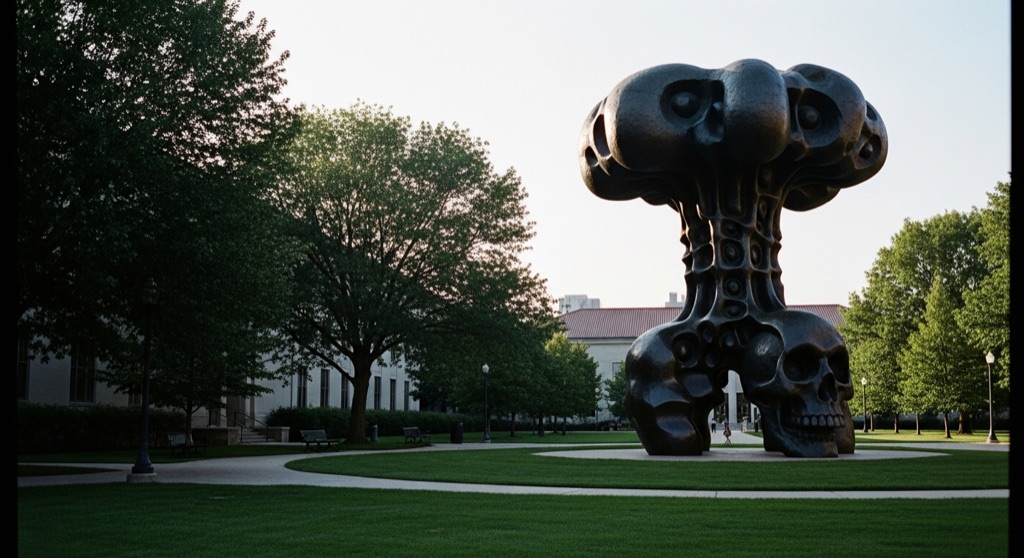
Nuclear Energy (Henry Moore sculpture)
Henry Moore's 1967 bronze marks the exact spot where Fermi's team triggered the world's first self-sustaining nuclear chain reaction under Stagg Field's bleachers in 1942. The bulbous crown was designed to read simultaneously as a mushroom cloud, a skull, and a cathedral dome — it was cast in over 50 pieces in Berlin and welded together like a giant 3-D jigsaw puzzle.
→ Three more oddity shops & curiosities in Chicago — never the same twice
The story
In December 1942, Enrico Fermi and his team quietly stacked 400 tons of graphite blocks and uranium inside a disused squash and racquets court beneath the west bleachers of Stagg Field. At 3:36 p.m. on December 2, they pulled control rods to trigger Chicago Pile-1, unleashing history’s first controlled, self-sustaining nuclear chain reaction. There were no press conferences or warning sirens—just a famously coded phone call announcing that 'the Italian navigator has landed in the New World.' By 1957, the stadium bleachers were torn down, leaving behind a blank plot of grass that contained one of the heaviest secrets in human history.
To mark the 25th anniversary of the reaction, the University of Chicago commissioned British sculptor Henry Moore. Cast in Berlin at the Noack foundry in over 50 separate bronze sections, the 12-foot piece was shipped across the Atlantic and assembled like a massive 3-D jigsaw puzzle. It was unveiled on December 2, 1967—at precisely 3:36 p.m.—under the official name *Nuclear Energy*, though Moore privately preferred the working title *Atom Piece*. The sculpture’s bulbous form is deliberately ambiguous: step around its perimeter and watch it morph from the rising stalk of a mushroom cloud into a hollow human skull, or step directly beneath it to feel the soaring interior curves of a cathedral dome.
Because the sculpture sits out in the open on Ellis Avenue, right between the brutalist slab of Regenstein Library and the sunken glass dome of Mansueto Library, hundreds of students walk past it daily without giving it a second glance. The university never put up velvet ropes or armed guards to shield ground zero of the Atomic Age. It rests on a low stone plinth exposed to Chicago winter wind, quietly challenging you to decide whether human ingenuity built a sanctuary or signed a death warrant.
What it's like
Visiting is completely low-key and self-guided. You will find the bronze sculpture standing outdoors on a paved campus quad along Ellis Avenue. Because there are no gates, admission fees, or docents, you can walk right up to the base, touch the welded bronze seams, and stand directly beneath the central vault to look up through its open arches. Campus foot traffic of library-bound students pulses past during weekday afternoons, but if you visit during early morning hours, dusk, or over a weekend, you can usually have the site to yourself. Pair your visit with a quick peer through the glass shell of the neighboring Mansueto Library next door.
The move: Stand under it on a quiet campus quad and argue about whether it looks more like doom or a dome — it was unveiled December 2, 1967, exactly 25 years to the day after the reaction it commemorates.
- 📍 Hyde Park
- 💸 Free
- ⚡ Up for anything
- 🌗 Outdoors
Where: Ellis Avenue between 56th and 57th Streets, University of Chicago, Chicago, IL 60637
Hours: Added 2026-07-19 — confirm current hours before you go.
Pair it with
- The Pub at Ida Noyes Hall — Walk four blocks southeast to debate the ethical weight of the Manhattan Project over cheap taps in a Gothic basement hideout.
- Fountain of Time — Head half a mile south to compare Moore's atomic skull with Lorado Taft's 1922 concrete procession of 100 shrouded figures facing Father Time.
- Garden of the Phoenix & Yoko Ono's Sky Landing — Stroll a mile east into Jackson Park to contrast Moore's ambiguous nuclear bronze with Yoko Ono's peaceful lotus-inspired steel installation.
- Promontory Point — Walk 1.3 miles east to sit on late-1930s limestone revetment blocks and clear your head against Lake Michigan's horizon.
More weird in Chicago



Good to know
Where is the Nuclear Energy sculpture located on campus?
It stands outdoors along Ellis Avenue between 56th and 57th Streets, directly in front of the Joseph Regenstein Library on the University of Chicago campus in Hyde Park.
What exact event took place at this spot?
It marks the precise location of Stagg Field's west bleachers, where Enrico Fermi's team achieved the world's first self-sustaining nuclear chain reaction on December 2, 1942.
Do I need tickets or reservations to see it?
No, it is an outdoor public artwork located on an open university quad, accessible 24/7 with no tickets required.
Why does the sculpture look like a mushroom cloud and a skull?
Sculptor Henry Moore designed the bronze piece with intentional dualities: the dome reads simultaneously as a mushroom cloud, a human skull, and a cathedral archway to reflect both the threat and power of atomic energy.
Plan a visit & invite your people →
Further reading: publicart.uchicago.edu · Wikipedia · mag.uchicago.edu · Reddit
last checked: 2026-07-19