Entry No. 110 — the Chicago file — filed under: ruins
Keepataw Preserve Lime Kiln
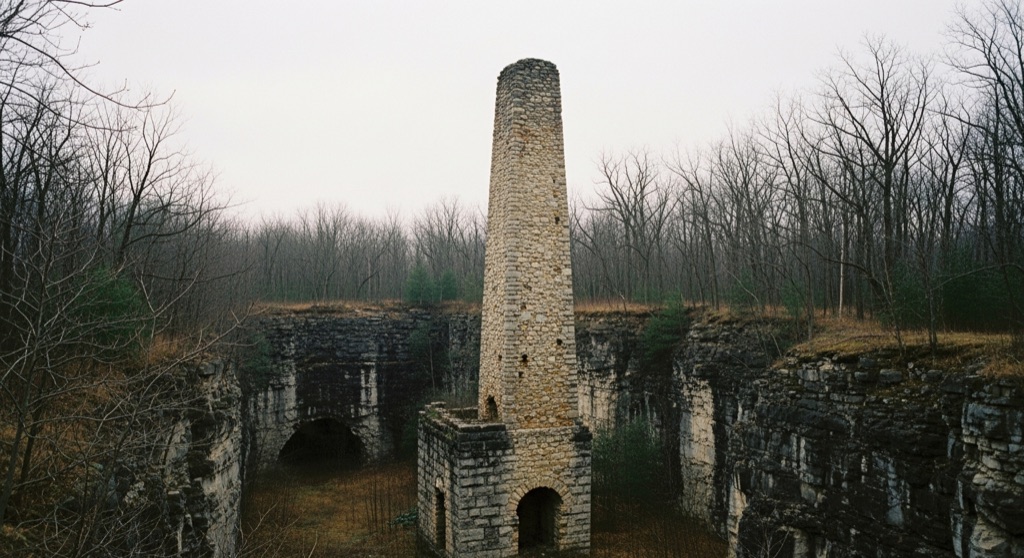
Located within the Keepataw Preserve, this abandoned limestone kiln is a relic of the region's late 19th-century quarrying boom. The most prominent remnant is a towering, 150-year-old stone chimney that once vented a furnace used to process dolomite limestone. Today, the crumbling structure is surrounded by regrown forest and can be spotted from nearby hiking trails.
→ Three at a time, never the same twice — explore weird Chicago
The story
If you’ve ever driven past the Des Plaines River valley along I-355, you might have caught a split-second glimpse of a weathered stone stack rising through the tree canopy. That isn't a remnant chimney from an old farmhouse—it's a 150-year-old industrial smokestack, the last standing piece of a late 19th-century lime kiln. Long before the 215-acre Keepataw Preserve was set aside by the forest preserve district, the Western Stone Company ran a massive quarrying operation on this land between 1889 and 1918, carving away stone that went into building early Chicago and the Illinois State Capitol in Springfield.
The lone stone tower served as the exhaust stack for a separate-feed patent kiln, a high-temperature furnace engineered to bake crushed dolomite limestone into quicklime for mortar and cement. When local stone production collapsed in the early 20th century under competition from Bedford limestone and modern concrete, the quarry was abandoned and stripped of its metal. Nature moved in fast: dense forest reclaimed the pit floor, trees wrapped around the old furnace footings, and a 60-foot quarried cliff face became an elevated bluff. Today, the crumbling stone stack stands stranded in the woods, looking more like an ancient ruin than a turn-of-the-century processing plant.
What it's like
Drive to the small gravel lot off Bluff Road and pick up the short, 0.28-mile mowed-grass loop trail that climbs to the 60-foot bluff overlook. If you visit in peak summer, the heavy leaf canopy makes the tan stone stack surprisingly tricky to spot through the trees; visit in late autumn or winter when the foliage clears for an unobstructed view. You can also spot the chimney from the adjacent paved Veterans Memorial and Centennial bike trails. Keep to the designated paths and don't try to bushwhack up to the stone itself—the 150-year-old masonry is structurally unstable and visibly crumbling, which is why viewing from a distance is strictly enforced.
The move: Hike the scenic trails of Keepataw Preserve to the overlook bluff, where you can spot the historic stone chimney rising through the trees and capture some unique photographs of this industrial relic.
📍 Before you go The kiln ruins are located within the publicly accessible Keepataw Preserve, but the crumbling stone chimney structure itself is structurally unstable and should only be viewed from the safety of the trails.
- 📍 Romeoville
- 💸 Free
- ⚡ Low-key
- 🌗 Outdoors
Where: Romeoville, IL 60446, USA
Hours: Added 2026-07-20 — confirm current access before you go.
Pair it with
- Palos Preserves (World's Largest Urban Night Sky Place) — Trade daytime industrial ruin hunting along the Des Plaines River bluffs for stargazing in a massive dark-sky preserve just 15 minutes east.
- Bachelor's Grove Cemetery — Extend your abandoned history tour eastward to explore one of Chicagoland's most famous overgrown, forgotten graveyards.
- Resurrection Cemetery (Resurrection Mary) — Follow the river valley northeast along Archer Avenue to see the heavy iron gates tied to Chicago's most famous ghost story.
- Galloping Ghost Arcade — Follow up a quiet walk past 19th-century stone ruins with a dive into over 800 glowing arcade cabinets in Brookfield.
More weird in Chicago


Good to know
Where in the preserve is the lime kiln chimney located?
The stone chimney stands in the forested area near the 60-foot bluffs inside Keepataw Preserve, visible from the preserve's trail overlook and from the adjacent Veterans Memorial Trail.
Can you walk up to or climb the kiln ruins?
No. The 150-year-old stone structure is structurally unstable and crumbling, so visitors are required to view it safely from the designated trails.
What are Keepataw Preserve's hours and entrance fees?
The preserve is free to enter and open daily from 8:00 a.m. until sunset year-round, except on Christmas Day.
What was the lime kiln used for?
Built during the late 19th-century quarrying boom, the kiln burned dolomite limestone at high heat to produce quicklime, a key component in 19th-century mortar, plaster, and agricultural soil treatments.
Plan a visit & invite your people →
Further reading: industrialhistory.org · openlands.org · frrandp.com · Reddit
last checked: 2026-07-20