Entry No. 19 — the Butte file — filed under: haunted
Berkeley Pit Viewing Stand
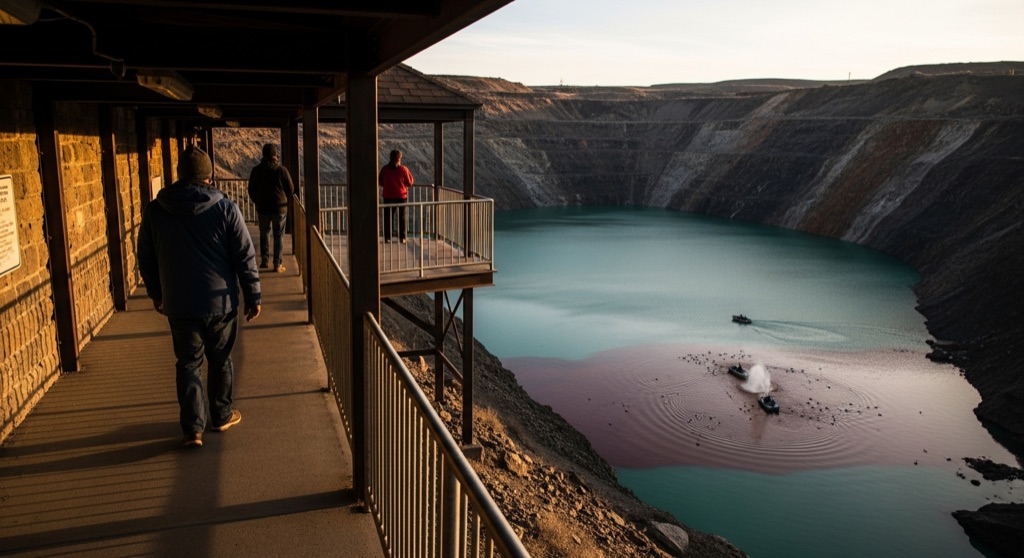
You walk through a short dim tunnel and emerge on a platform staring down into a flooded open-pit copper mine roughly a mile long, now a 900-foot-deep lake of acidic, metal-laden water tinted a strange rust-and-teal. It sits within the largest contiguous Superfund site in the country, and the water is lethal enough that in 2016 thousands of migrating snow geese died after landing on it. A recorded narration and interpretive panels explain the mine's history while you take in the eerie scale of the toxic lake.
→ Three more haunted places & dark-history spots in Butte — never the same twice
The story
To dig the Berkeley Pit starting in 1955, the Anaconda Copper Mining Company didn't just chew up earth—it swallowed whole working-class neighborhoods on Butte's East Side. Entire historic communities like Meaderville and McQueen were purchased, bulldozed, and scooped away so massive electric shovels could reach the copper underneath. Over nearly three decades, miners extracted more than 290 million tons of copper ore. But when operations ceased in 1982, the underground pumps keeping the water table at bay were shut off for good.
Without active pumping, billions of gallons of groundwater and surface runoff flooded the 1,600-foot-deep pit. As the water rose, it dissolved heavy metals and iron sulfides from the exposed rock, turning the crater into a 900-foot-deep lake with an acidic pH hovering around 2.5—roughly equal to vinegar. The surreal color of the water isn't paint or chemical dye; extremophile bacteria like Acidithiobacillus ferrooxidans thrive in the toxic broth, shifting the lake's color between rust-red, turquoise, and sickly teal depending on the season and chemical state.
Sitting at the heart of the country's largest contiguous Superfund site, the lake is lethal to visiting wildlife. In November 2016, a severe blizzard forced thousands of migrating snow geese to land on the surface, where thousands died from acidic ingestion and toxic shock. Today, mine operators run a surreal, continuous war against nature: crews patrol the crater using propane noise cannons, gas-powered remote-controlled boats, spotlights, and drones to keep migrating birds moving past the pit before they can touch down.
What it's like
You park at 300 Continental Drive, hand over a few dollars at the small gift shop counter, and walk through a short, dark concrete tunnel. When you step out onto the cantilevered viewing platform, the sheer scale of the abyss hits you immediately. It feels less like an overlook and more like standing on the rim of an alien landscape, complete with the occasional muffled boom of propane cannons echoing off the terraced rock walls. Aim to visit late in the afternoon near golden hour: the low sunlight brings out the stark contrast between the orange rock terraces and the neon turquoise water, and you might spot the hazing crews operating drone boats across the surface.
The move: Pay the few-dollar admission, walk the tunnel out to the platform together at golden hour, and watch the bird-hazing boats and noise cannons work to keep waterfowl off the deadly lake.
📍 Before you go Viewing stand is seasonal, roughly mid-May through mid-September, daily ~10am-5pm; small admission fee. The water is dangerous; stay on the platform.
- 📍 Butte (Uptown / East side)
- 💸 Free
- ⚡ Up for anything
- 🌗 Outdoors
Where: 300 Continental Dr, Butte, MT 59701
Hours: Added 2026-06-24 — confirm current hours before you go.
⚠ Seasonal or scheduled — always check before you go.
Pair it with
- Granite Mountain / Speculator Mine Memorial — Pair this toxic open-pit overlook with the hilltop memorial honoring the 168 miners lost in Butte's tragic 1917 hard-rock mining disaster.
- Helsinki Bar (Helsinki Yacht Club) — Follow up the site of Butte's swallowed East Side with a drink inside the last remaining structure of vanished Finn Town, built in 1911 as a miner bathhouse.
- Rookwood Speakeasy — Match the massive scale of Butte's surface mining crater with a visit to a subterranean Prohibition speakeasy sealed behind a closet until 2004.
- Dumas Brothel Museum — Contrast the industrial destruction of Butte's historic neighborhoods with a tour of the red-light district brothel that survived 92 continuous years of operation.
More weird in Butte
Good to know
Why is the water in the Berkeley Pit so acidic and toxic?
When underground pumping stopped in 1982, rising groundwater reacted with pyrite and heavy metal minerals in the exposed rock, creating sulfuric acid with a pH around 2.5 and high concentrations of copper, arsenic, cadmium, and zinc.
What happened to the historic neighborhoods that used to stand here?
Beginning in the 1950s, the Anaconda Copper Mining Company purchased and demolished entire working-class neighborhoods on Butte's East Side—including Meaderville and McQueen—to clear land for open-pit mining.
How do operators stop migrating birds from landing on the toxic lake?
Mine personnel run a year-round waterfowl hazing program using propane noise cannons, gas-powered drone boats, spotlights, sound wailers, and aerial drones to frighten birds away before they land.
What are the seasonal hours and admission fees for the viewing stand?
The viewing platform and gift shop are open seasonally from roughly mid-May through mid-September (typically daily around 10am to 5pm, weather permitting) for a small admission fee of around $2 to $3.
Plan a visit & invite your people →
Further reading: pitwatch.org · Wikipedia · Roadside America · Atlas Obscura · audubon.org
last checked: 2026-06-24